


World Suicide Prevention Day falls on the 10th of September every year, and in 2026 its theme is “Changing the Narrative on Suicide” — a call to replace silence and stigma with honest, compassionate conversation. As a clinical psychologist who has spent over 13 years working with people in crisis, I want to use this day to share what the evidence actually says: about the scale of the problem, the myths that keep people from seeking help, the warning signs worth taking seriously, and what a psychologist’s role really looks like in prevention.
What Is World Suicide Prevention Day?
World Suicide Prevention Day is observed every 10th September, established by the International Association for Suicide Prevention (IASP) and supported by the World Health Organization (WHO). The 2026 theme, “Changing the Narrative on Suicide,” is the final year of a three-year focus (2024–2026) aimed at challenging harmful myths, reducing stigma, and encouraging open dialogue — a “Start the Conversation” call to action for individuals, families, workplaces, and governments alike.
The Numbers: What WHO’s Data Tells Us
According to the World Health Organization, more than 720,000 people die by suicide every year worldwide — and many more attempt it. Suicide is the third leading cause of death among 15–29-year-olds globally, making it a leading contributor to preventable death in young people specifically.
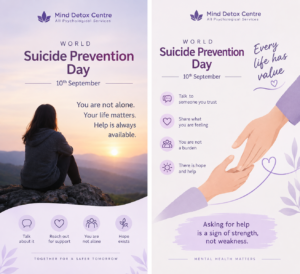
Roughly 73% of global suicides occur in low- and middle-income countries, which reflects, in part, how limited access to mental health care and continued stigma shape outcomes. These are not just statistics — each figure represents a person, a family, and very often, a preventable tragedy.
Common Myths About Suicide — And the Facts
Changing the narrative starts with correcting what most people get wrong. These are the myths I hear most often in my clinic:
Myth: “Asking someone if they’re suicidal will put the idea in their head.”
Fact: Research consistently shows the opposite. Asking directly and calmly does not increase risk — it often brings relief, because it opens a door the person may have been too afraid to open themselves.
Myth: “People who talk about it don’t actually do it.”
Fact: Most people who die by suicide have shown warning signs beforehand, including talking about it. Every mention should be taken seriously, not dismissed as attention-seeking.
Myth: “Suicide only affects people with a diagnosed mental illness.”
Fact: While mental health conditions, especially depression and alcohol use disorders, are significant risk factors, suicide can also affect people going through acute life crises — grief, financial collapse, relationship breakdown — without any prior diagnosis.
Myth: “If someone is determined to end their life, nothing can stop them.”
Fact: Suicidal crises are frequently short-lived and situational. Timely support, restricting access to means, and professional care save lives far more often than fatalism assumes.
Warning Signs Worth Taking Seriously
No single sign confirms risk, and not everyone shows obvious signs — but these patterns are worth taking seriously, especially in combination:
- Talking about wanting to die, feeling like a burden, or having no reason to live
- Withdrawing from family, friends, or activities they once enjoyed
- Giving away possessions, saying goodbye, or getting affairs in order
- Marked changes in sleep, appetite, or mood — including a sudden, unexplained calm after a period of depression
- Increased use of alcohol or drugs
- Expressions of hopelessness or being trapped, with no way out
If you notice several of these signs together, especially after a significant loss or life crisis, it is time to reach out — to them, and to a professional.
Risk Factors and Protective Factors
The WHO identifies several factors that raise vulnerability: mental health conditions (particularly depression and alcohol use disorders), a previous suicide attempt, exposure to violence, abuse, or conflict, major life crises such as financial loss or relationship breakdown, and social isolation — with additional vulnerability among refugees, migrants, indigenous communities, LGBTI individuals, and people in custodial settings.
Protective factors matter just as much: strong, supportive relationships, a sense of belonging and purpose, access to mental health care, healthy coping and problem-solving skills, and cultural or personal beliefs that discourage suicide while supporting help-seeking.
The Role of a Clinical Psychologist in Suicide Prevention
This is where my own work comes in, and it looks quite different from how it’s often portrayed. A clinical psychologist’s role in suicide prevention typically includes several distinct pieces.
Risk assessment. Rather than trying to “predict” suicide with a checklist, modern clinical practice — as described in guidance for assessment and intervention with at-risk patients — focuses on understanding a person’s specific drivers of distress, their current supports, and their access to means, to build an accurate, individualised picture of risk.
Safety planning. Together with the client, we build a concrete, personalised plan: recognising their own warning signs, identifying coping strategies, listing people and professionals they can contact, and reducing access to means during high-risk periods. This collaborative approach is one of the most evidence-supported tools in suicide prevention.
Treating the underlying condition. Depression, anxiety, trauma, grief, and chronic relational distress are frequently the real engines behind suicidal thoughts. Evidence-based therapy — addressing the cause, not just the crisis — is central to long-term prevention, not just short-term safety.
Postvention support. Psychologists also support families and communities after a suicide loss, helping survivors process grief that is often complicated by guilt, stigma, and unanswered questions.
Building resilience before crisis hits. A large part of prevention is proactive: helping people build the emotional regulation, communication, and problem-solving skills that make future crises less likely to escalate — which is exactly why early, ongoing mental health support matters, not only crisis intervention.
How to Talk to Someone You’re Worried About
If you’re worried about someone, the most useful thing you can do is ask directly, calmly, and without judgment: “I’ve noticed you haven’t seemed like yourself — are you having thoughts of suicide?” Listen without trying to fix everything in that moment. Avoid arguing, minimising (“but you have so much to live for”), or reacting with shock or panic. Stay with them, or make sure they are not left alone, and help them connect to a helpline or a mental health professional as soon as possible.
WHO’s LIVE LIFE Approach to Prevention
The WHO’s LIVE LIFE initiative outlines four evidence-based strategies for national and community-level prevention: limiting access to the means of suicide, encouraging responsible media reporting, building socio-emotional life skills in adolescents, and ensuring early identification, assessment, and follow-up care for people at risk. On an individual level, the same logic applies — remove immediate danger, build coping skills, and get professional support early rather than waiting for a crisis.
Helplines and Immediate Support in India
If you or someone you know needs support right now, these are active, confidential helplines in India:
Tele MANAS — 14416 (24/7, toll-free, Government of India’s national tele-mental health service)
KIRAN Helpline — 1800-599-0019 (24/7, toll-free, Ministry of Social Justice and Empowerment)
AASRA — +91 98204 66726 (24/7)
iCall (TISS) — +91 9152987821 (Monday–Saturday)
Vandrevala Foundation — +91 9999 666 555 (24/7)
You can also reach out to a local psychiatrist, clinical psychologist, or your nearest hospital’s emergency department. Seeking help is not a weakness — it is the single most effective step toward safety.
Frequently Asked Questions
- Is it safe to ask someone directly if they’re suicidal? Yes. Research consistently shows that asking directly does not increase risk and often provides relief to the person struggling.
- What should I do if someone tells me they’re having suicidal thoughts? Take it seriously, listen without judgment, avoid leaving them alone if risk seems high, and help them connect with a helpline or mental health professional immediately.
- Can therapy really help someone at risk of suicide? Yes. Evidence-based approaches, including safety planning and therapy for underlying depression, anxiety, or trauma, are strongly associated with reduced risk over time.
- What is the theme of World Suicide Prevention Day 2026? The 2026 theme is “Changing the Narrative on Suicide,” the final year of a three-year (2024–2026) global focus on reducing stigma and encouraging open, compassionate conversation.
A Final Word from Dr. Rabya Umman
Every World Suicide Prevention Day, I’m reminded that most of the pain I see in my clinic was carried silently for far too long before someone finally asked the right question, or someone finally felt safe enough to answer honestly. Changing the narrative on suicide starts with exactly that: one honest conversation, one person willing to listen, one door left open instead of closed.
If you are struggling, or supporting someone who is, please know that professional help is available and effective. You can reach out about psychotherapy and counselling or mental health treatment at Mind Detox Centre — and if it feels urgent right now, please use one of the helplines listed above before anything else.
If you are in crisis, please call Tele MANAS on 14416 or KIRAN on 1800-599-0019 — both are free, confidential, and available 24 hours a day.
